Earlier this month, our team spent four days at ExCeL London for ESHRE 2026, alongside roughly 8,000 clinicians, embryologists, and researchers from across the world of reproductive medicine. It is one of the few times a year the entire field is in one room. We went to show what we have been building. We came back with something more useful: a clearer picture of where fertility care is heading. Three shifts stood out, and they all point in the same direction.
Why we were at ESHRE 2026
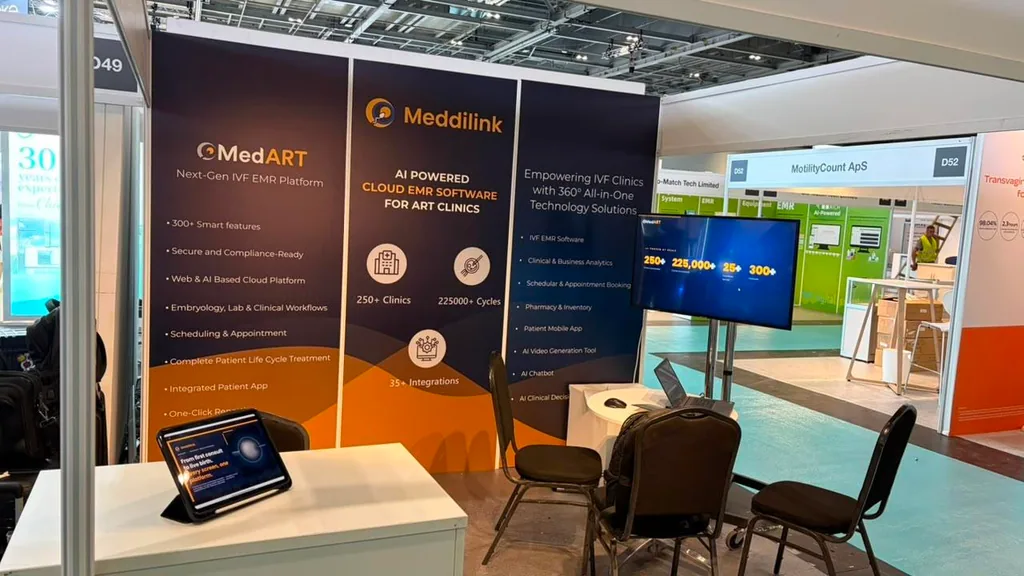
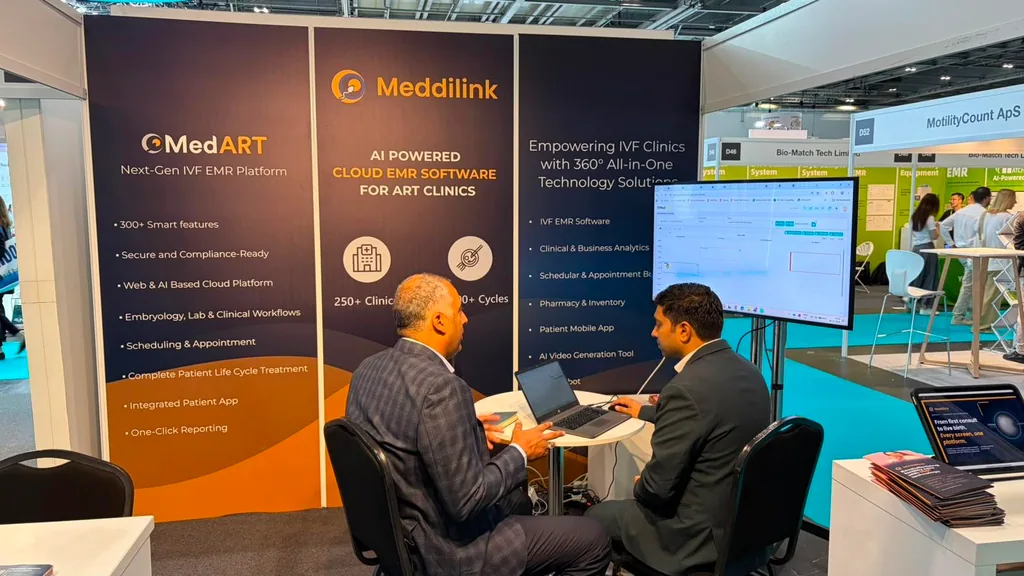
We exhibited at booth #D050, running live demonstrations of MedART alongside MedAI-X, MedX, MedAI Scribe, and MedCryo. We had lined up booth meetings in advance and spent most of the four days walking clinic and lab teams through the platform in person. Those conversations, as much as the sessions on stage, shaped what follows.
The three shifts that stood out
They emerged from very different corners of the event — the sessions on stage, the exhibition floor, the conversations at our own booth — but they all landed in the same place: the industry is done chasing single features, and starting to ask structural questions about how fertility care actually gets built.
1. AI is growing up
The loudest topic, unsurprisingly, was AI. But the tone has changed. A year or two ago, the conversation was full of bold claims about algorithms outperforming embryologists. This year it was calmer and more honest. The most rigorous trial to date found that AI and experienced embryologists performed about the same at selecting embryos, a result that quietly deflated some of the hype and refocused the room on where AI actually helps today.
And that turned out to be the unglamorous work: standardising embryo assessment, easing documentation, supporting follicle monitoring, and taking manual load off stretched teams. AI in the fertility clinic is maturing from a headline into a tool. The clearest example is what it is already doing with clinical documentation. The clinics getting real value from it are the ones using it to remove busywork, not to replace judgement.
2. Evidence is becoming the default
The second shift ran through nearly all the science on show: fertility care is becoming genuinely data-driven. Study after study reinforced decisions clinics can now make from evidence rather than instinct, from the continued case for single embryo transfer to sharper thinking on when genetic testing does and does not add value.
The through-line is that a clinic’s own data is becoming its most valuable asset. We have argued before that evidence is starting to beat experience in IVF, and ESHRE made that feel less like a prediction and more like the present. The clinics pulling ahead are the ones that can actually see and learn from their own outcomes, instead of relying on memory and gut feel.
3. The tech stack is consolidating
The third shift was strategic. Across the exhibition floor, and in the networks expanding through acquisition, you could feel the move away from a drawer full of disconnected point tools toward a single, connected platform.
It makes sense. When the clinical record, the lab, the embryology data, and patient communication all live in separate systems, someone spends their day reconciling them by hand, and no one can see the whole picture. This is exactly why the embryology and andrology records belong at the centre of the system, not bolted on the side. The appetite we saw was clear: fewer systems that talk to each other, not more systems that don’t.
The question we kept hearing: does it hold up at scale?
The most revealing part of the week, though, was not in any of the takeaways. It was in a question we heard again and again at the booth, usually right after a demo: “Does it still perform when the cycle load goes up?”
Clinic and lab directors were not asking about features. They were asking about load. Does efficiency hold when volume doubles, when a second lab comes online, when the team is already stretched thin?
It is exactly the right question to ask. The field’s real ceiling on growth right now is capacity, a shortage of embryologists set against rising cycle volumes, and much of the industry’s interest in automation is about lifting that ceiling by handling more cycles without losing consistency or safety. So a platform’s true test is not how it looks in a demo. It is whether it holds its efficiency, and its data integrity, under real clinical load. That a room full of experienced directors kept returning to this tells you where their attention is: not on novelty, but on whether technology can carry weight.
It is the thread that ties all three shifts together. As I put it to a few of the teams we met:
“As someone who builds this technology, I’ve come to see a modern platform as a clinic’s core operating system. It lets care teams make data-backed decisions that improve success rates, and it connects the work across clinicians, embryology labs, operations, devices, and third parties through smart, automated workflows. That is what keeps a clinic sustainable, compliance-ready, and effective in how it treats patients. Investing now in one unified system that works across every clinical and lab function is the right call, and in the end, it shapes the patient experience too.”
What it means for fertility clinics
Put the three shifts together and a picture forms. AI is becoming a practical tool, decisions are becoming evidence-based, and clinics want one connected system rather than many disconnected ones, all of it under growing pressure to scale without breaking.
The clinics that do well over the next few years will not be the ones chasing the flashiest single feature. They will be the ones building a solid, connected core they can grow on, and trust under load. That is the clinic we built MedART for.
Topics

Co-Founder, Meddilink EMR
Prashant Talesara is a co-founder of Meddilink EMR, the purpose-built IVF EMR platform. He is also Co-Founder & CTO at Datareel.ai — where he focuses on AI-powered hyper-personalization — and a Co-Founder at Kansoft. His work centers on building scalable technology that empowers industries, bringing engineering leadership and an AI-first approach to the products he helps create.