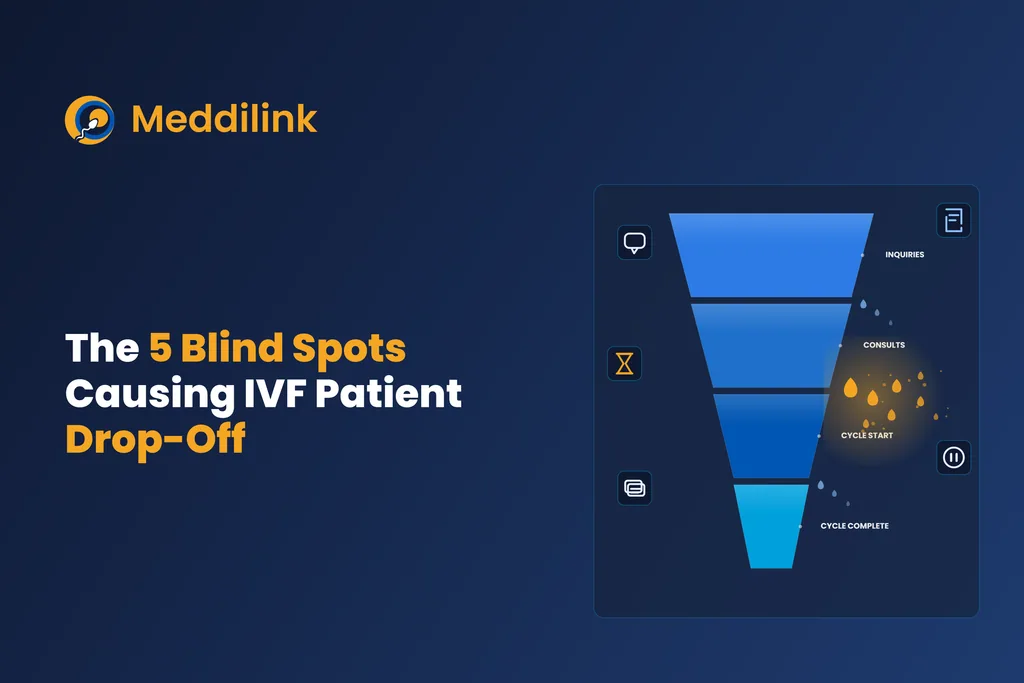
Most fertility clinics treat their patient app as a checkbox — an accessory that comes with the EMR, or a communication add-on the marketing team asked for. The clinics pulling ahead treat it differently: as a standalone product in the technology stack, deserving its own evaluation criteria, its own success metrics, and its own strategic attention. This piece is for fertility-clinic decision-makers thinking about the patient app the way they’d think about the EMR itself — because the app is where most of the patient’s daily interaction with your clinic actually lives.
Why IVF Deserves Its Own Patient App
Generic healthcare apps handle appointments, records, and messages the same way for every specialty. A diabetes patient, a cardiology patient, and an IVF patient get essentially the same experience — a calendar, a document folder, a chat thread. For most of medicine, that’s enough. For IVF, it isn’t.
Fertility care is uniquely time-critical. Ovarian stimulation medications must land at specific hours to hit specific hormonal windows. Monitoring scans time the trigger injection to within a two-hour window. The trigger times the retrieval to within thirty minutes. Embryology grades time the transfer decision. Every clinical action in the cycle depends on the one before, and the sequence adjusts mid-cycle when the patient’s biology doesn’t match the protocol. A generic health app that shows “your next appointment is Tuesday” cannot support this. What patients need is an app that knows what day of stimulation they’re on, what medication is due at what hour, what the last scan showed, and what changes if the ovarian response is faster or slower than expected.
Then there’s the emotional context. Patients undergoing IVF often move through the treatment with elevated stress — carrying financial burden, work commitments, uncertain outcomes, and a sequence of medical procedures that are new to them. Information overload, unclear instructions, and inconsistent communication amplify that stress. A well-designed patient app doesn’t eliminate the emotional weight of treatment — but it can reduce the operational friction that compounds it.
Finally, IVF is increasingly a cross-border service. Clinics in the UAE, Georgia, Kazakhstan, Malaysia, and other medical-tourism hubs serve patients whose first language isn’t the clinic’s operating language. Language friction in these cases isn’t a UX preference — it’s a direct hit on adherence, satisfaction, and outcomes. Generic health apps default to the clinic’s language. Fertility-specific apps that ship native multi-language coverage change the equation entirely.
How MedX Fits Into a Fertility Clinic’s Stack
MedX is Meddilink’s IVF patient app — a standalone product in the Meddilink lineup, sitting alongside MedART (the IVF EMR), MedAI Scribe (voice-to-text documentation), MedXbot (AI patient front-desk), MedAI-X (AI patient-education video), and MedCryo (cryopreservation management). It is not a MedART module or a MedART feature — it is a distinct product with its own engineering team, its own release cadence, and its own iOS and Android app-store presence under the clinic’s or Meddilink’s brand.
MedX is built for clinics running MedART. This is deliberate. The cycle-stage-aware reminders, real-time medication schedules, and lab-result sync that give MedX its clinical value all depend on deep integration with the underlying EMR — a level of integration that isn’t possible against a generic third-party EMR without rebuilding both platforms. Clinics evaluating MedX typically evaluate MedART and MedX together as the paired clinic-and-patient side of the same platform. Where the clinic is committed to a different EMR, we recommend one of the many EMR-agnostic patient apps on the market — with the caveat that most of them cannot deliver cycle-stage-aware reminders because they lack the underlying data connection.
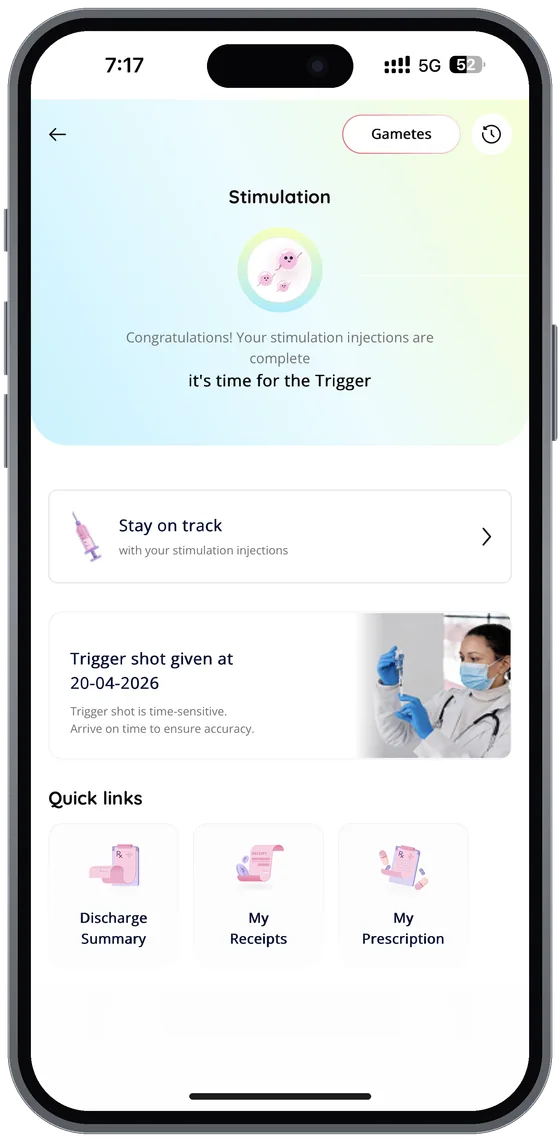
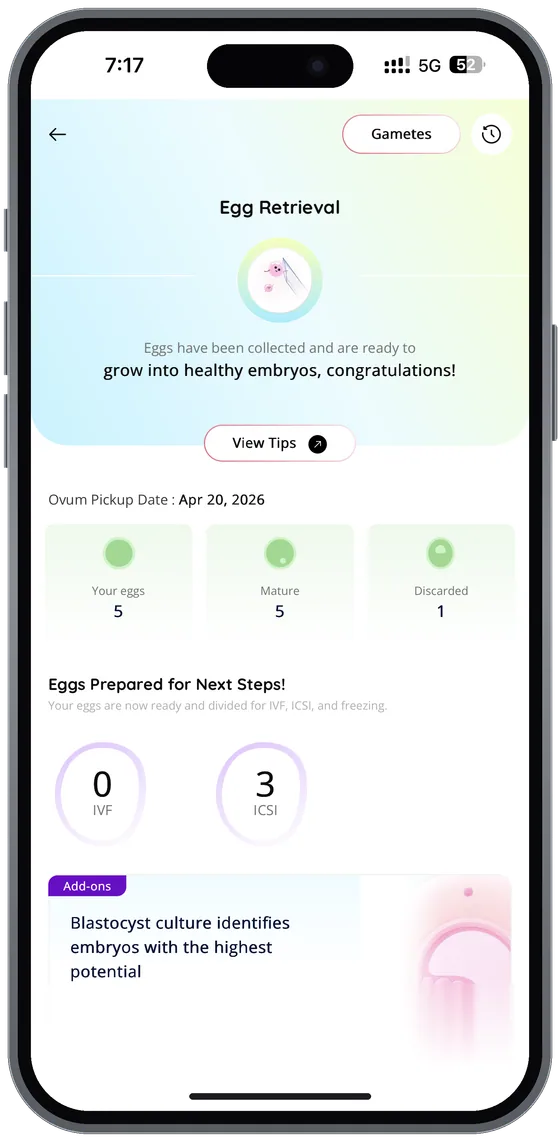
Below is a look at what MedX shows the patient during an active cycle. Each screen is designed around the one clinical question the patient is trying to answer at that moment in their day.
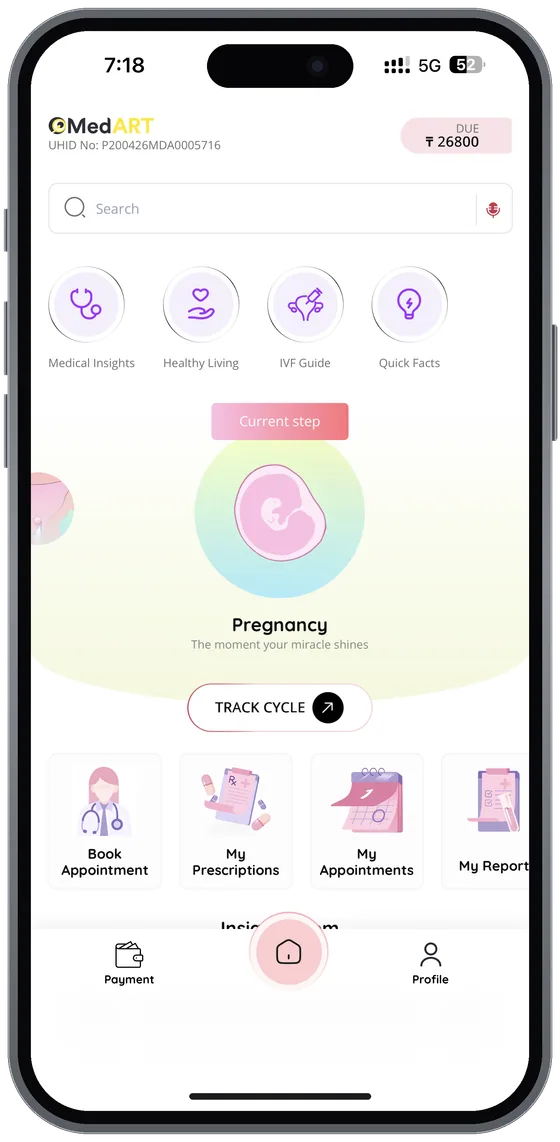
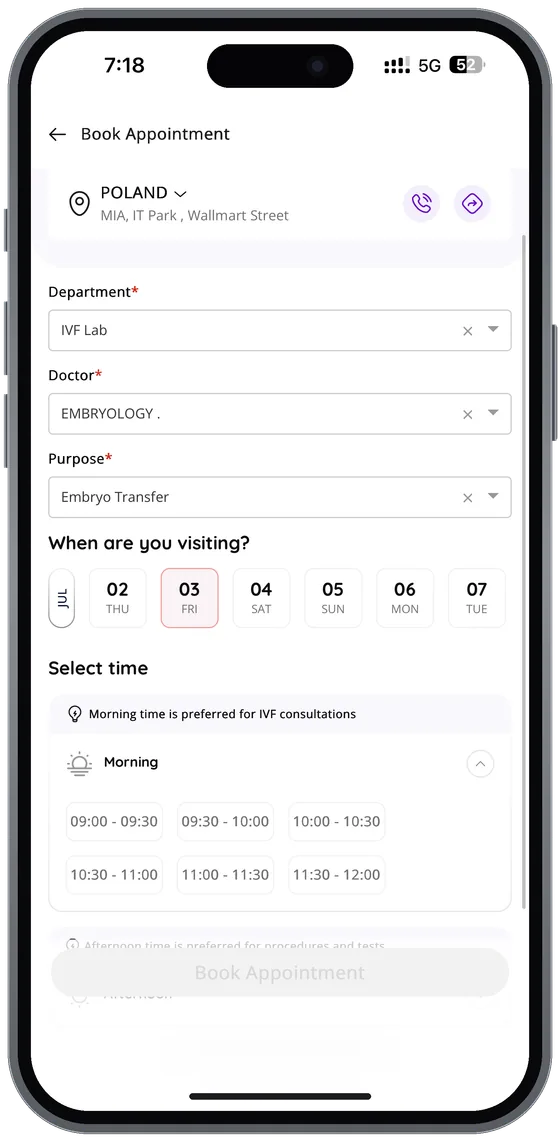
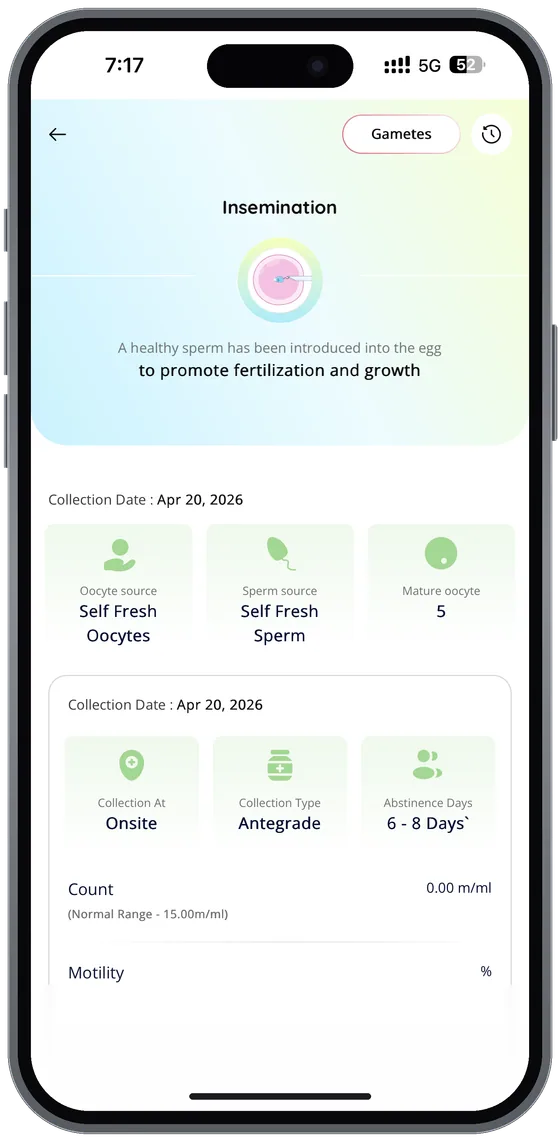
For the full feature scope, iOS/Android download details, and clinic-side configuration — see the MedX product page.
The Adherence Math — What Numbers Actually Change
A patient app’s value proposition is measurable at three levels: missed medication doses, appointment no-shows, and mid-cycle drop-outs. Every clinic tracks these — though most track them as post-hoc reports rather than as real-time metrics that shape decisions. The clinics that treat the patient app as a strategic product start seeing measurable improvement in each within the first cycle of adoption.
From live Meddilink deployments, MedX delivers up to 25 to 40% reduction in missed medication doses and up to 60% reduction in appointment no-shows through cycle-aware reminders in the patient’s own language. The mechanism is straightforward: a reminder that knows what dose is due at what hour lands at the right time; a reminder in the patient’s own language is read more often than one in English. The specific gains vary by clinic baseline, patient demographic, and adoption depth — these are ranges across our client deployments, not guaranteed outcomes for any single clinic. But the direction of the effect is consistent.
The multi-language angle deserves its own emphasis. Cross-border patients are one of the highest-value segments in most clinics’ funnels — and also one of the most sensitive to language friction. When a Russian-speaking patient at a Kazakhstan clinic gets her injection reminder in Kazakh or English, the reminder becomes a translation task first and a clinical instruction second. When the same reminder arrives in Russian, the friction disappears. Multi-language coverage is not a feature — it’s the difference between having cross-border patients as revenue and having them as unfulfilled inquiries.
The patient-satisfaction lift compounds these operational gains. Patients who feel supported and informed complete cycles at higher rates and refer other patients more often. There is a deeper argument for why messaging quality moves conversion at the top of the funnel in our 9 messaging signals piece; the same discipline applied inside the patient app moves adherence and retention through the middle and bottom of the funnel.
What to Evaluate Before Choosing an IVF Patient App
The market has more patient apps in 2026 than most clinics have time to evaluate. The following six criteria separate apps that will move your adherence numbers from apps that will just look modern in a sales demo.
Cycle-stage awareness
Ask specifically: does the app know what day of stimulation the patient is on? Can it adjust medication reminders when the physician updates the protocol mid-cycle? Or is it a calendar with medical wallpaper? An app that shows “your next appointment is Tuesday” is not the same product as an app that shows “you’re on Day 5 of stimulation, your Gonal-F 225 IU is due at 7 PM, and your monitoring scan tomorrow will decide if we adjust the dose.”
EMR integration depth
Surface-level integration (the app pulls appointments from the EMR via API) is not the same as deep integration (the app syncs medication changes, cycle-protocol updates, lab results, and messaging in real time). Ask how the sync works. Ask what happens when the physician changes a dose during a monitoring visit — does the patient see the update within a minute or within a day? The answer separates apps that operate as sync layers from apps that operate as pretty read-only dashboards.
Multi-language reach
Ask what languages are supported natively (as opposed to via runtime translation). For cross-border patient markets, native-language support at the reminder and instruction level is a substantial adherence lever. Runtime Google-Translate-style translation adds latency and mistranslation risk.
Data-sync fidelity
Batch sync (updates every N minutes) vs real-time sync (updates within seconds of the EMR change) matters more than most buyers realise. In fertility care, a dose adjusted at 2 PM must reach the patient before their 7 PM injection window. A batch sync that runs every 30 minutes can be fine. A batch sync that runs overnight cannot.
Security posture
Confirm the encryption model at rest and in transit, the authentication method (password only, or biometric/OTP), the audit-trail granularity, and where the data is physically stored. HIPAA-Ready and GDPR-Ready framing on the product page should be backed by architectural specifics on request. Compliance badges without architecture specifics are marketing decoration.
Rollout and training model
Ask what the implementation team looks like on the vendor side, what the training scope is for coordinators, and what the patient-onboarding script looks like. A patient app is only as good as its adoption — apps with strong architecture but poor rollout support don’t deliver the numbers.
The Retention Lever Most Clinics Miss
The most consequential effect of a well-designed patient app is not what it does inside a cycle — it’s what it does across cycles. Mid-cycle drop-out (patients who start a cycle and don’t complete it) and between-cycle drop-off (patients who complete one cycle and don’t return for the next when clinically indicated) are the largest hidden costs in most clinics’ operations.
Patients who use an app that keeps them informed, that lets them reach the clinic without picking up the phone, that translates medical instructions into their own language, and that carries their full history from cycle to cycle stay engaged at meaningfully higher rates than patients who don’t. The retention math compounds — every patient retained across a cycle boundary is a patient whose next cycle marketing cost is essentially zero.
We’ve mapped out the specific patterns behind IVF patient drop-off in a companion piece: 5 blind spots causing IVF patient drop-off. The patient app is one lever — the largest single operational one — but it sits inside a broader retention system that includes messaging quality, appointment coordination, and how the clinic handles the emotional weight of unsuccessful cycles.
For clinics thinking about their patient app as more than a checkbox — MedX is available for evaluation as a paired product with MedART. The evaluation conversation is best had with your own patient-adherence numbers in hand.
Topics

Product Head — MedART
Preeti Pamecha is Product Head for MedART, the purpose-built IVF EMR platform powering fertility clinics across 25+ countries. She leads the product roadmap across MedART's 17+ modules — clinical documentation, embryology, andrology, laboratory, billing, patient-360, analytics, and beyond — translating how IVF care actually happens on the ground into what the platform does next. She works closely with fertility clinic leaders, embryologists, and lab directors to make sure every release reflects real clinic workflows, not assumptions about them.