For a fertility clinic, the ART workflow is the load-bearing wall. When the coordination between clinician, embryologist, andrologist, and patient stays tight, cycles complete on schedule, cryo hand-offs land clean, and success rates hold. When it slips — a missed cryo renewal notice, a PGT report that never made it back into the record, a stimulation adjustment the lab did not hear about — the cost is measured in cancelled cycles and shaken patient trust.
And planning breaks in exactly the same places every time. Not because clinicians make bad decisions, but because the data those decisions depend on lives across a stack of disconnected systems: the clinical EMR, an embryology spreadsheet, a cryo logbook, a scheduling tool, a lab result PDF sitting in someone’s inbox. Somebody spends their day reconciling all of it by hand, and no one can see the whole picture.
That is the problem MedART was built to solve. MedART is an end-to-end ART workflow optimization platform for fertility clinics — one connected system where every stage of the cycle, from ovarian stimulation to embryo transfer, runs on shared data instead of on hand-offs between disconnected tools.
What is end-to-end ART workflow optimization?
End-to-end ART workflow optimization is the practice of running every stage of an assisted reproductive technology cycle — consultation, ovarian stimulation, oocyte retrieval, fertilisation and embryology, cryopreservation, embryo transfer, and follow-up — on a single shared data model, so no stage depends on information being re-typed out of another system.
The distinction matters because most clinics already have software for the individual stages. What they lack is continuity between them. A stimulation adjustment recorded in the EMR, a grading result recorded in the lab, and a thaw booked in the cryo logbook all describe the same cycle — but if they live in three systems, the cycle exists nowhere in full.
Optimising the workflow end-to-end means three things in practice:
- One record per cycle, written to by every role — clinician, embryologist, andrologist, coordinator — rather than one record per department.
- Events propagate, so a fertilisation result or a PGT report updates the cycle view without a hand-off.
- The plan and the schedule are the same object, so changing a protocol moves the appointments bound to it.
For the clinical documentation layer underneath all of this — patient records, STIM protocols, OPU and ET documentation — see ART cycle planning in the Clinical EMR module.
Where ART cycle planning breaks — and why
Talk to any clinic director about their cycle-planning pain and you’ll hear the same five failure modes:
- Tracking multiple cycles simultaneously — juggling 30, 100, or 500 active cycles per month across different stimulation days, retrieval dates, and transfer windows, with no unified view of who’s where.
- Managing cryopreservation end-to-end — freeze events, storage location, witness records, thaw scheduling, and renewal billing, all typically maintained in a separate logbook the clinician cannot see.
- Handling embryo transfers with precise timing — endometrial receptivity windows, hormone thresholds, transfer readiness — coordinated across the clinical, embryology, and scheduling teams.
- ICSI case management — sperm sample selection, documentation, and witness sign-off, traceable back to the individual patient cycle.
- PGT workflow integration — sending biopsies out to a reference genetics lab and getting reports back into the correct embryo record without a paper hand-off.
Without a single system holding all of this, manual re-entry becomes the default. Manual re-entry produces mismatches. Mismatches, in fertility care, produce cancelled cycles.
That’s on top of the compliance load — cycle-level audit trails for RTAC, Nabidh, Malaffi, SART, or ESHRE registry reporting, depending on which region you operate in.
How MedART simplifies each phase of the ART cycle
MedART is Meddilink’s IVF-specific EMR platform — 17+ purpose-built modules that share a single data model. For ART cycle planning specifically, six of those modules do the heavy lifting.
1. Clinical EMR — the cycle spine
Every active ART cycle lives on one dashboard with stage, next action, owner, and any exceptions flagged in real time. Because the clinical record, embryology lab, cryo inventory, and scheduler share one data model, a status change anywhere in the workflow — a fertilisation result, a PGT report, a thaw event — updates the cycle view without anyone re-typing it.
Multi-clinic networks see the same view scoped by centre or rolled up across the network. That’s how a 175-centre deployment stays coherent (more on that below).
2. Embryology — from gamete to transfer
Gamete-to-transfer tracking, Gardner / Istanbul grading, time-lapse imaging integration, and PGT-A/M report attachment — all bound to the correct embryo, all in the same record the clinician sees. Witness sign-off is captured digitally rather than on a paper form that has to be scanned back in.
For ICSI cases specifically, every sperm sample is documented and traceable back to the individual patient cycle — the requirement for regulatory audit, and the difference between a clean investigation and a chart nightmare when something needs to be verified after the fact.
3. MedCryo — cryopreservation traceability that actually works
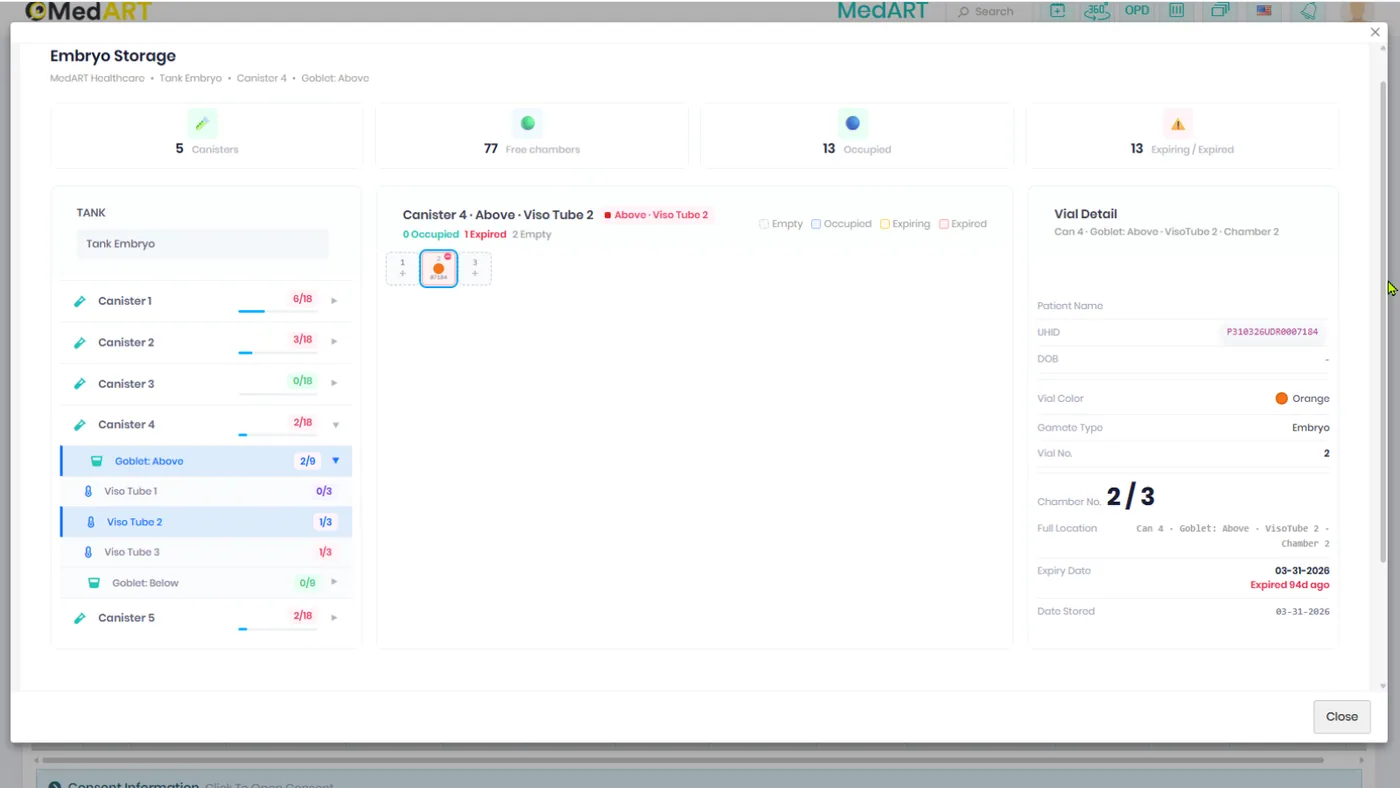
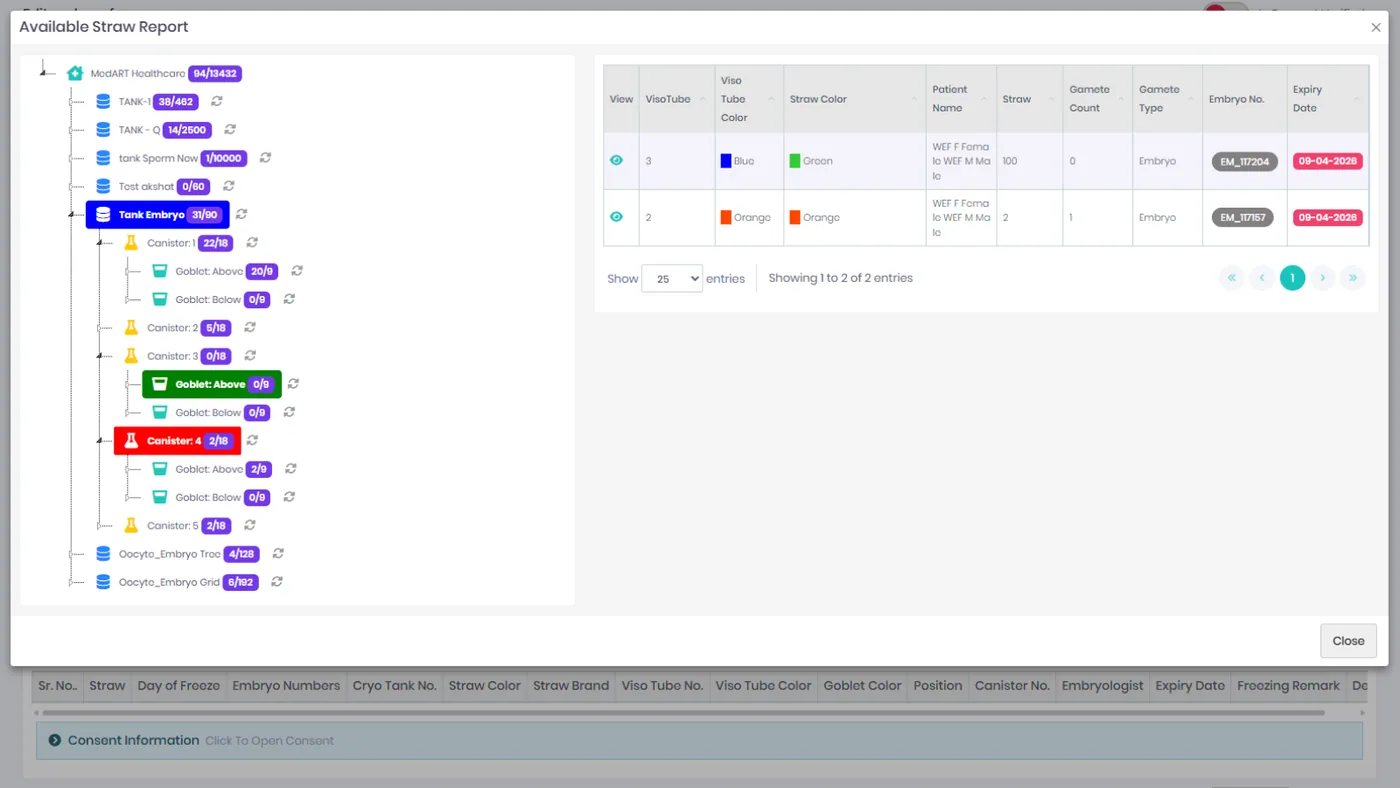
Every gamete, embryo, and tissue sample carries a chain-of-custody record: witness signatures, storage location, tank and cane position, and every freeze/thaw event. The cryo module ties directly into the cycle record — so a scheduled thaw pulls the exact sample identified in the plan, with no manual look-up.
Cryo renewal notices, expiry alerts, and billing triggers fire automatically. That’s meaningful because renewal-notice failure is one of the most common sources of clinic-vs-patient friction (and, in some jurisdictions, legal exposure).
4. Scheduler — cycle-aware, not just calendar-aware
A cycle-aware scheduler knows that a stimulation Day 8 scan cannot slip past Day 9, that an OPU has to land within a defined window after trigger, and that a transfer is bound to a specific endometrial-preparation timeline. Multi-resource booking (clinician, OT, embryologist, ultrasound room) is coordinated in one view.
Automated WhatsApp reminders to the patient close the loop on the appointment side — because a perfectly-timed cycle plan still fails if the patient doesn’t turn up.
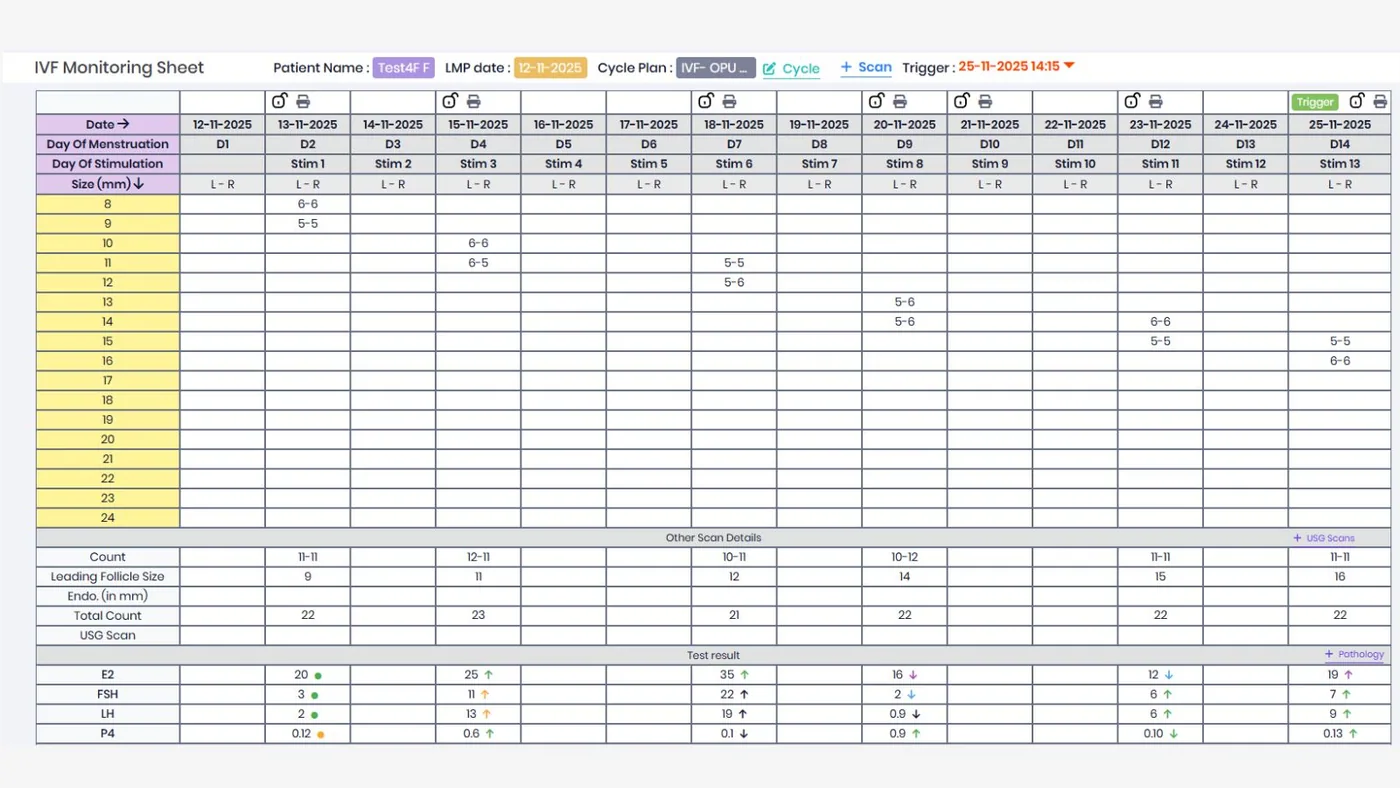
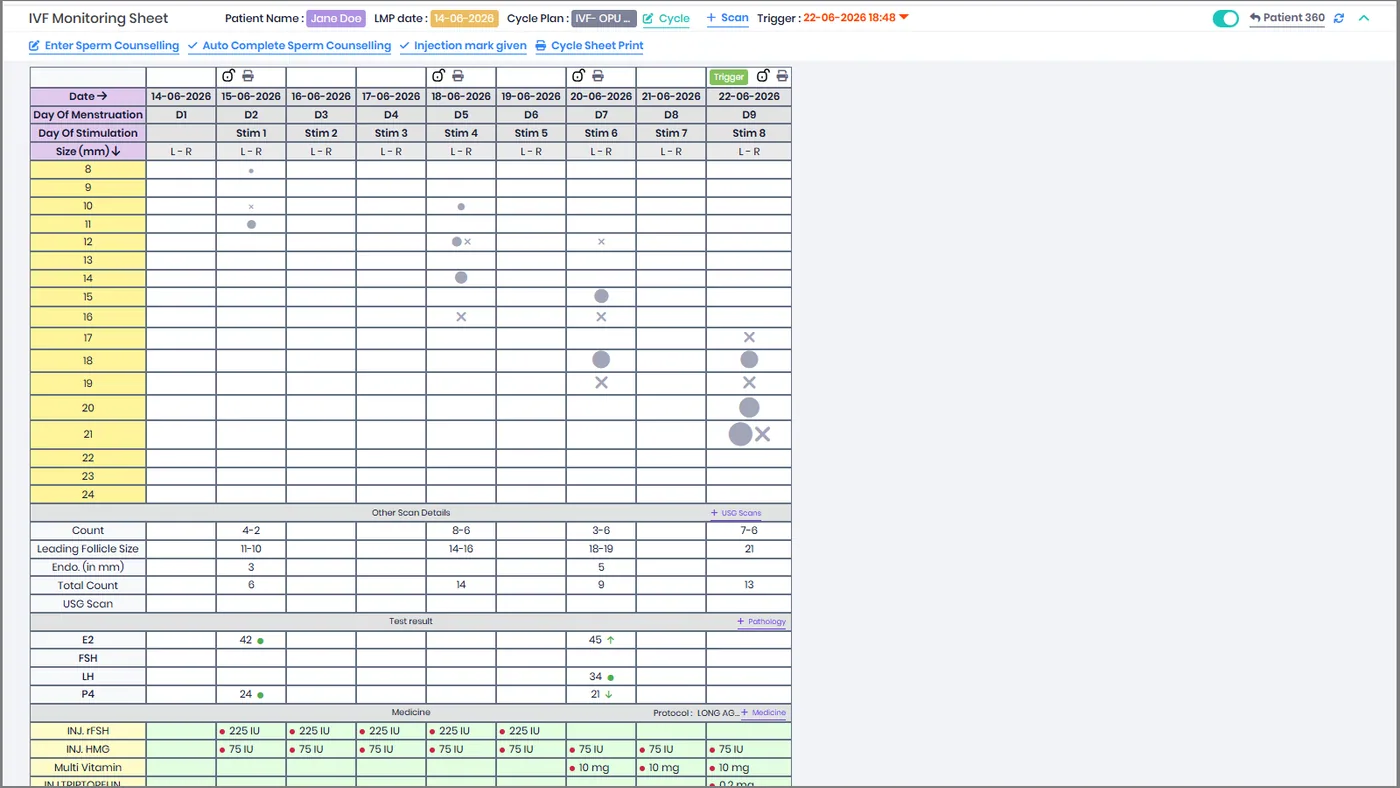
For the ovarian stimulation phase specifically, our Smart Stimulation Sheets handle protocol design with data-driven personalisation based on AMH, AFC, age, and prior-cycle response — feeding the planned protocol straight into the cycle dashboard the scheduler is working from.
5. Patient 360 — one screen, whole journey
The unified patient view pulls clinical history, cycle stages, financials, consents, lab results, communication log, and cryo inventory into a single screen. The clinician stops toggling between tabs; the coordinator stops hunting for context before a call.
6. AI Scribe — the documentation load, removed
Voice-to-text clinical documentation, IVF-optimised. Consult notes, procedure summaries, and cycle updates dictate straight into the cycle record — clinicians reclaim time that used to be spent typing, and the documentation is complete before the next patient walks in.
What does a streamlined fertility workflow look like in practice?
A streamlined fertility workflow is one where the number of times a person re-enters data that already exists is close to zero. That is the whole measure. Every other benefit — fewer errors, faster decisions, fewer cancelled cycles — follows from it.
Concretely, inside MedART:
- The stimulation plan is built from AMH, AFC, age and prior-cycle response, and the monitoring appointments it implies are booked from that same plan.
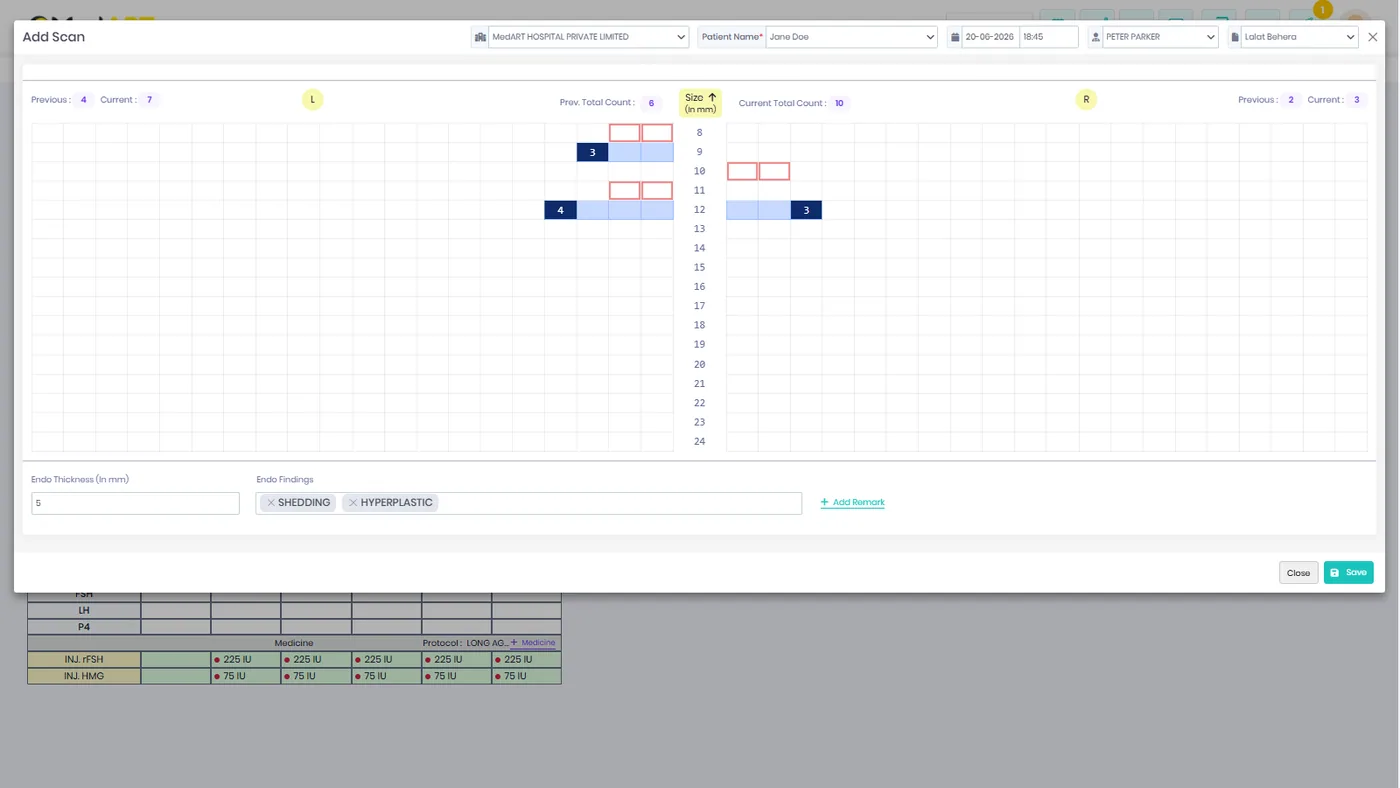
- A monitoring scan result updates the cycle dashboard, and a protocol adjustment re-times the downstream appointments bound to it.
- Retrieval hands the oocyte count straight to embryology — nobody transcribes it.
- Embryology grading, time-lapse observations and PGT reports attach to the individual embryo record the clinician is already looking at.
- Cryopreservation events write chain-of-custody data the scheduler reads when a thaw is planned, so the right sample is pulled without a manual look-up.
- Billing draws on procedures and consumables already recorded, rather than a parallel data-entry pass.
Clinics evaluating fertility clinic cycle optimization software usually start by asking which features a platform has. The more useful question is how many hand-offs it removes — because the hand-offs are where cycles get cancelled.
For multi-provider clinics standardising protocols across teams, IVF stimulation governance covers the policy layer that sits on top of this.
What this actually delivers — with real numbers
The claim that a unified platform “reduces errors” is easy to make; the claim only matters when there are numbers behind it from a real deployment. Ours come from Indira IVF — Asia’s largest fertility network — running 175+ centres across India, Nepal and Bangladesh, 2,700+ professionals, and 290+ IVF specialists on MedART:
- 40% operational efficiency gain through streamlined data access and reduced paperwork
- 30% faster decision-making via live KPI tracking and 200+ parameter BI dashboards
- 25% higher patient conversion on the back of a more personalised patient journey
- 70% reduction in paper use across the network
The clinical outcome came directly from the Indira IVF leadership:
“During our IT transformation journey we explored multiple EMR solutions specifically for fertility clinical practice — MedART came out a clear winner for its functional capabilities and the new-edge technology platform it is built on. Their BI dashboards have given us great insights into patient care, improving our success rate and overall management.”
— Rajesh Chavan, CTO, Indira IVF
Does it hold up at multi-clinic scale?
The load test on any ART cycle platform is not how it looks in a demo — it’s whether it holds efficiency and data integrity when volume rises and a second, third, or twelfth centre comes online.
Ecomed Clinics — Kazakhstan’s ISO-certified IVF network, established 1995 — runs 12+ integrated clinics and 200+ clinical and lab users on MedART, with a multilingual UI supporting Russian, Kazakh, and English for regional adoption.
“MedART improved access to information, coordination, and clinical decision-making across our network.”
— Marat Kaldybayevich Otarbayev, Ecomed Clinics
The point of both examples is not the individual number — it’s that a single platform that unifies clinical, lab, cryo, and scheduling data holds up under real clinical load, at scale. That’s the difference between “a nice tool” and “the clinic’s operating system.”
What your clinic gets, on day one
For clinics adopting MedART for ART cycle planning:
- One dashboard for every active cycle, with real-time visibility across clinician, embryologist, andrologist, and coordinator
- Cryopreservation chain-of-custody — witnessed, timestamped, tied to cycles, with automated renewal notices
- Cycle-aware scheduling with multi-resource booking and WhatsApp patient reminders
- PGT + CASA integration — reports and results flow into the correct record without paper hand-off
- AI-enabled documentation — voice-to-text scribe optimised for IVF, cutting the documentation load substantially
- Compliance-Ready architecture — audit trails, encryption, role-based access designed to support HIPAA, GDPR, and regional registry frameworks (RTAC, Nabidh, Malaffi, SART, ESHRE reporting)
- Patient-facing app — cycle visibility, prescription reminders, lab results, consent e-signing on the same platform
Implementation is delivered in phases so live cycles are not disrupted — typically approximately 4–8 weeks, scoped per engagement. Data migration from your legacy system is available and scoped per engagement.
Where to next
If ART cycle planning is the bottleneck you’re trying to move, the fastest way to see whether MedART fits is to walk through your current cycle load with our team. Bring the numbers — cycle volume, cryo inventory size, PGT lab workflow — and we’ll show you the exact dashboards Indira and Ecomed are working from.
Topics

Product Implementation Lead · CSPO®, CSM®
Ravi Chhajed is a Product Implementation Lead specializing in healthcare SaaS, including EMR and IVF systems. He focuses on clinical workflow automation and AI-enabled product delivery. Ravi holds the Certified Scrum Product Owner (CSPO®) and Certified ScrumMaster (CSM®) certifications, bringing an agile approach to delivering and implementing clinical software.