Choosing lab management software for a fertility clinic is harder than most buyers expect. The category sits at the intersection of clinical documentation, specialised workflows for embryology and andrology, laboratory equipment integration, regulator-specific reporting, and long-horizon traceability that has to survive years of cryostorage. Generic lab information systems weren’t designed for it, and hospital EMRs adapted for IVF rarely reach the depth a working lab needs. This guide walks through what IVF lab management software actually does, which features are non-negotiable in 2026, how compliance and traceability requirements shape the buying decision, and a six-step framework for evaluating the right platform for your clinic.
Why Generic Software Doesn’t Work for IVF Labs
Three categories of tooling fail fertility labs in specific ways.
Manual spreadsheets and paper logs worked in the earliest days of IVF but scale poorly. Cycle-by-cycle patient timelines, embryology grade tracking, andrology results, cryostorage inventories, and audit trails all end up in disconnected files that nobody has time to reconcile. Errors compound quietly. Reports take days rather than minutes. Chain-of-custody becomes a story rather than a record.
Generic Lab Information Systems (LIS) are built for general clinical labs — chemistry panels, microbiology, pathology. They can log a specimen and produce a report, but they don’t understand IVF cycles. There is no native concept of an oocyte moving through fertilisation, culture, transfer, and cryopreservation, no built-in Gardner or Istanbul grading, and no traceability of gametes across years and freeze-thaw events.
Generic hospital EMRs adapted for IVF cover breadth but fall short on depth. They can document a consultation and generate a bill, but the embryology-specific work still lives in separate desktop tools or spreadsheets. The clinic ends up paying twice — for the base EMR and for the customisation to make it behave like an IVF system — and gets neither the coverage of a purpose-built platform nor the operational simplicity of unified data.
What IVF Lab Management Software Actually Does
IVF lab management software is a purpose-built digital system that documents, tracks, and analyses every event in the fertility laboratory — from oocyte pickup and semen analysis, through fertilisation and embryo culture, embryo grading and biopsy, transfer, and multi-year cryopreservation and disposition. When it’s part of a broader IVF EMR (rather than a standalone tool), it also synchronises with the clinical side of the platform so that lab events sit inside the patient’s cycle timeline in real time.
The software’s job is not just to record. At its best, it validates data as it’s entered (dropdowns and controlled vocabulary instead of free text), captures every user action with a time-stamped audit trail, links each embryo to its patient across every future event, generates the specialised reports regulators expect, and surfaces analytics that help the lab understand its own performance over time.
Must-Have Features in Modern IVF Lab Management Software
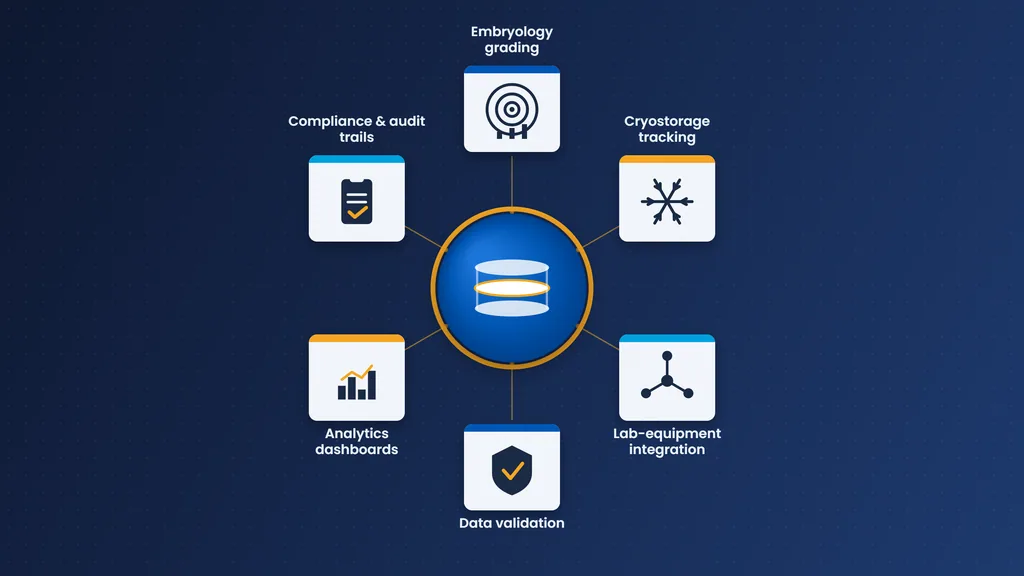
A modern IVF lab platform has to cover six feature categories credibly. The infographic below summarises how they connect around a unified lab platform; each is unpacked in detail beneath it.
Embryology and andrology documentation
The embryology module must support Gardner and Istanbul grading as structured data — not free-text notes — plus time-lapse imaging integration, PGT-A and PGT-M result linking, and full traceability from oocyte retrieval through disposition. The andrology module needs WHO 6th edition semen analysis, CASA integration, and cryopreservation tracking. Both modules should link natively to the clinical cycle timeline so an embryologist grading at 2 AM sees the same patient context the physician saw at consult.
Structured grading data depends on structured capture. AI Scribe handles the clinical side of that record so embryology and consultation notes land in the same data model.
Sample tracking and cryostorage management
Every gamete and embryo needs a unique identifier that survives multi-year storage, thaw cycles, and transport between facilities. Modern lab software tracks cryotank contents, storage renewals, thaw events, and disposition against the patient record — turning long-term storage from an inventory-management problem into a full audit trail. The full cryo management workflow deserves its own attention; the short version is that it needs to be native to the lab platform, not a spreadsheet bolted on the side.
Integration with lab equipment and third-party systems
Modern IVF labs run on a diverse equipment stack: analyzers, incubators, time-lapse imaging (EmbryoScope and equivalents), PGT provider portals, and electronic witnessing systems (RI Witness, Matcher, and similar). Rather than replacing these systems, IVF lab management software should integrate with them via HL7, DICOM, and validated connectors — capturing their events into the patient record in real time. Meddilink ships MedART with 35+ validated integrations across the fertility equipment ecosystem, including partner integrations for the leading electronic witnessing platforms so witnessing events remain linked to the patient timeline.
Data validation and error reduction
Free-text entry on critical clinical fields is a compliance liability and a quiet source of quality drift. Modern lab platforms enforce controlled vocabulary through dropdowns and validated pick-lists on grading, sperm parameters, cryostorage location codes, and disposition status — dramatically reducing typos, mis-recorded grades, and audit findings. What used to require a second pair of human eyes now happens at input time.
Analytics and lab-performance dashboards
Lab performance improves fastest when it’s visible. AI-powered analytics surface trends in fertilisation rates by physician, blastocyst development rates by protocol, embryo survival after cryopreservation, and lab quality drift before outcomes suffer. Dashboards should slice by embryologist, technique, protocol, patient age cohort, and cycle type — turning every completed cycle into a learning signal rather than a filed record.
Compliance and audit trails
Every clinical action needs a time-stamped, user-attributed log. Role-based access controls prevent unauthorised viewing or editing; audit trails record who did what and when. When a regulator, an internal quality manager, or a patient’s legal counsel asks for the full history of a specific gamete or embryo, the platform should produce it in minutes — not days of forensic spreadsheet-hunting.
How IVF Lab Software Ensures Compliance and Traceability
Compliance in fertility labs is a growing global concern. Different jurisdictions expect different registries and formats — the laboratory module inside a purpose-built IVF EMR should ship reports for the major bodies rather than leave clinics to custom-build every year.
International registries and standards: SART (US), HFEA (UK), ESHRE (Europe), CAP and NABL for lab accreditation, ICMR (India). Each demands its own data model, submission cadence, and format expectations. Software that ships these as configurable outputs — with the correct field mapping already validated against real submissions — cuts weeks of manual reconciliation per registry cycle.
Regional regulators: NABIDH (Dubai), MALAFFI (Abu Dhabi), KARM (Kazakhstan), PSRM (Philippines), MMC (Malaysia), BPOM (Indonesia), and Türkiye’s ÜYTE. Multi-national fertility networks operating across these regions run parallel reporting practices — the right software supports each without duplicating documentation effort.
Electronic witnessing integrations are increasingly the standard of care during major audits. RI Witness, Matcher, and equivalents provide the double-check on every gamete and embryo movement; IVF lab software should integrate with these platforms so witnessing events link to the patient record rather than sit in a separate audit log.
Audit trails, e-consent, and role-based access are baseline. Every clinical decision, embryology grade change, and disposition update should carry a timestamp and a user identity that survives export.
How Lab Software Connects with Your Clinical EMR
The most valuable IVF lab software is not a standalone tool. It’s a module inside a broader clinical platform where lab events, clinical decisions, patient communication, and financial workflows all reference the same underlying record. Meddilink’s MedART is built this way from the ground up — the lab and clinical modules aren’t integrated after the fact, they share the same patient timeline natively.
The practical value shows up in daily work. Stimulation records feed into oocyte retrieval planning without re-entry. Semen analysis is visible to the physician deciding on fertilisation approach. Embryo grades appear alongside the clinical decision to transfer or freeze. Cycle summaries generate in a click because every event is already linked. Outcomes reporting slices by physician, protocol, or age cohort because the data structure supports it.
Where the lab module is bolted onto a generic hospital EMR, none of this happens automatically — the clinic ends up paying for integration work that would have been free in a purpose-built platform.
How to Choose the Right IVF Lab Management Software
Six steps separate substantive evaluations from marketing-tour demos. Work through them before signing anything.
Step 1Audit your lab’s current pain points
Before evaluating vendors, catalogue exactly where your current workflow breaks: manual grade entry, paper witnessing logs, cryostorage tracking in spreadsheets, delayed report generation, audit-preparation lag, disconnected communication between the lab bench and the clinician’s office. Write these down before any demo. A vendor’s software should solve your specific problems — not just showcase impressive features you’ll never use.
Step 2Map your regulatory reporting requirements
List every registry your clinic files to — SART, HFEA, ESHRE, CAP, NABL, ICMR, and any regional bodies like NABIDH, MALAFFI, KARM, or PSRM. For each, note the required data fields and submission cadence. Then ask vendors whether these reports ship out-of-the-box as configurable outputs, or whether they’ll require custom development every year. This one criterion will separate substantive vendors from marketing-heavy ones.
Step 3Assess your integration ecosystem
List every piece of lab equipment and every third-party system the software will need to talk to: analyzers, incubators, time-lapse systems (EmbryoScope and equivalents), PGT providers, electronic witnessing systems (RI Witness, Matcher), cryostorage monitoring, and your existing clinical EMR. Distinguish between validated out-of-the-box connectors and one-off custom builds — the difference shows up in both timeline and ongoing maintenance cost. A vendor with 35+ validated integrations reflects investment; a vendor promising “we can integrate anything” often means custom-build fees.
Step 4Evaluate the vendor’s track record with similar clinics
Ask how many clinics are running the platform in production today, and specifically how many at your scale, in your region, and with your equipment stack. Then ask to talk to two of them without vendor mediation — direct contact, no middlemen on the call. Vendor-mediated references are useful; unmediated references are the truth. A vendor that hesitates on this is telling you something you should hear before signing.
Step 5Understand implementation, training, and data migration
Get a written implementation plan before you sign — not a sales-deck slide. It should specify a dedicated implementation team on the vendor side, a designated project owner on your side, an explicit training schedule for embryologists and clinicians, and a data-migration path that names your source system. Modern IVF EMR implementations typically take approximately 4–8 weeks; data migration is scoped separately based on source system complexity, data volume, and required cleansing depth.
Step 6Compare pricing models and total cost of ownership
Vendors price by user, by site, or by cycle. None of these is inherently better — the right model depends on your clinic’s staff count, site count, and case volume. Ask for a total three-year cost projection including all typical add-ons: integrations, training refreshes, additional user seats, and data-migration engagements. The license fee is often the smallest line in the true total cost.
Real-World Impact: What Clinics See After Adoption
The measurable gains from moving to purpose-built IVF lab management software compound across the cycle. Clinics running MedART’s lab modules report an approximate 40% reduction in manual data-entry time, faster cycle planning with auto-linked lab events, better preparedness for NABL and CAP audits, increased transparency in patient consultations, and improved cycle outcomes through data insights that surface protocol drift before it shows up in results.
The largest deployment on the platform — Indira IVF’s 100+ clinic network across India, Nepal, and Bangladesh — uses the same lab, embryology, andrology, and clinical modules across every branch while maintaining per-branch protocol variants where clinical leaders wanted them. Leadership sees cycle outcomes, embryology performance, and financial rollups in near real-time, sliced by branch, physician, or protocol. That’s the operational shape modern lab management software is built to deliver.
Topics

Product Head — MedART
Preeti Pamecha is Product Head for MedART, the purpose-built IVF EMR platform powering fertility clinics across 25+ countries. She leads the product roadmap across MedART's 17+ modules — clinical documentation, embryology, andrology, laboratory, billing, patient-360, analytics, and beyond — translating how IVF care actually happens on the ground into what the platform does next. She works closely with fertility clinic leaders, embryologists, and lab directors to make sure every release reflects real clinic workflows, not assumptions about them.